This story is part of The Engine Behind the Epic, a Level Infinite feature series spotlighting the teams powering our partner studios behind the curtain.
Somewhere in Singapore, an artist is finishing a character up-res. By the time the file leaves their machine, the same model will end up living three lives: a cinematic inside the game, a Steam key visual on the storefront, and a printed Displate that fans hang on their walls. None of those deliverables started with a brief that said “use the same model.” That is just how the Infinite Creative Center, or ICC, cooks.
ICC is Level Infinite’s in-house creative team. Forty artists across the UK, Singapore and China with backgrounds that run from films to AAA game development and advertising. Their creative runs from co-dev like cinematics, visual language and technical artistry through to marketing like trailers, key visuals and in-game screenshots. This spans the length of a game’s lifecycle from concept to holding the long tail of a release together. They sit inside the publisher, not outside as an agency, and that distinction is the entire piece.
We sat down with Richard Parnes, Director of ICC, to walk us through how the kitchen actually works. The metaphor is his: the studios create the ingredients, ICC does the cooking, and the rule of the house is nose-to-tail. Nothing goes to waste.
In the kitchen, not at the door
When we asked Richard to name the single biggest creative difference between being inside a publisher and being an external agency, he didn’t hedge. The priority, he told us, is helping the studios sell as many units as possible. “That is our focus.” An external agency’s focus, on the other hand, is “profit, EBITDA and awards” for its own business. Cold, but useful framing. It explains what ICC gets to do what an agency cannot.
What it unlocks is access. Studios let ICC into rooms an external vendor would not get within a hundred meters of. The proprietary engine. The gate-review conversations. “Studios don’t see us as just another entity trying to make money off of them as we share the same north star.” Richard says.
The other thing it unlocks is the right to look at the whole game. ICC is not only a marketing asset supplier. The team works on cinematics that go inside the build, both realtime and pre-rendered cutscenes, technical optimization passes, visual language and characters for storytelling. Inside ICC, the same person who makes a trailer can also make an engine cinematic. This is what makes the nose-to-tail process possible.
Nose to tail
The line comes from the culinary world. The philosophy is simple: you respect your ingredients enough to ensure nothing goes to waste. ICC works the same way on a game. A character model uprezzed for an in-engine cinematic becomes the hero of a key visual. Cuts from a trailer become the bones of a how-to series on social media. Because ICC as ‘Chef’ sees the whole game as ‘Kitchen’, so they can always find the second and third dish.
“Diversification is key,” Richard says. ICC’s strongest contributors are the ones comfortable working across the full pipeline. He pointed us at Eric Leong, a senior animator on the team who joined in 2023 after many years at Industrial Light & Magic, working on Marvel films and the Star Wars franchises. Eric’s canvas today requires a much more agile kind of mastery. One week it is a cinematic that tells the story of the game, the next week it is gameplay footage for fifteen-second TikTok edit a player watches on their phone. Eric’s transition, and transcendence, from working purely in the film space to being able to work in not just the storytelling of games but the advertising of them as well,” Richard says. “I think Eric and his becoming of a Swiss army knife is emblematic of what I would want for anyone in ICC,”
That is the team that makes nose-to-tail work in practice. You need cooks who can pivot from a Hollywood-grade hero shot to a fast-cut social edit without losing the thread.
The Into the Infinite Showcase, from inside the kitchen
The Into the Infinite Showcase is one of the pieces Richard says ICC is most proud of. The showcase format itself is not new. Xbox and PlayStation have been doing long-form publisher reveals for years. The traditional way to run one is to fly to a stage in Germany, hire a film crew, light it, shoot it, post it.
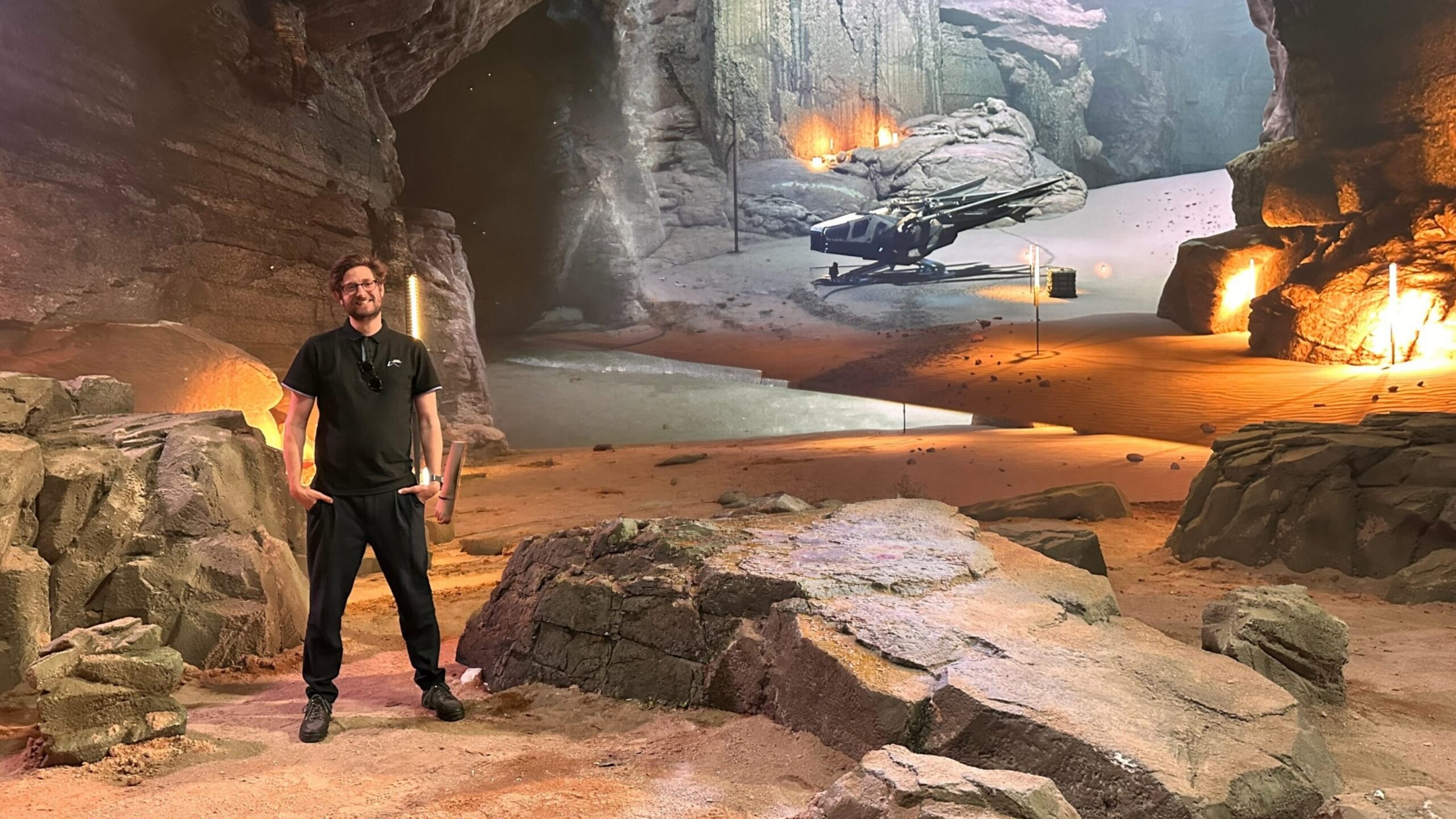
ICC’s pitch was different. Use the studios’ game worlds as the stage. The sets are already built, because games are full of finished environments. Load these assets into Unreal Engine for virtual production stages. Run camera tracking. Put the hosts, studio leads and game directors in front of the LED wall, and let them walk through the worlds they spent years making while they talk us through them.
“What more authentic ways to communicate the game world than having the developers walk around the game worlds themselves while they talk to the players?” Richard says. Funcom’s Chief Creative Officer Joel Bylos had a moment walking the virtual stage on Arrakis to talk about the game, and he said, “The whole universe of Arakkis brought to life. I was kind of blown away!”
It’s also a creative-identity statement for Level Infinite as a publisher. Most publisher showcases project credibility with refined production quality. The Into the Infinite Showcase stands apart by leveraging unique access: we have the studios, we have the worlds, and we are confident enough to put the developers themselves on stage inside their own work.
Dune: Awakening
By the time Joel finished his walkthrough at the Into the Infinite Showcase 2024, Funcom and ICC had a clearer read on each other, and the conversation kept going.
What followed: Chapters 1 and 2 of the in-game cinematics, then Chapter 3, and the major upcoming update, plus a run of assigned custom cutscenes. Technical optimization on the dev side, the Steam key visual on the front of the storefront and a host of visual post-launch content.
The story trailer that came out of the cinematic work was an extremely high performing asset for the game in the year that followed, with a 99% like ratio on YouTube after millions of views. The line landed because the trailer was built like a Hollywood story trailer rather than a feature reel. “We tried to make it feel Hollywood,” Richard says. A story trailer for an immersive game.
The how-to series for TikTok came out of a different challenge. Dune: Awakening has deep systems that deserve to be articulated. Stash access, crafting, gear customization. Long-form trailers cannot teach those. But short, fast cuts can. ICC’s approach was that dense systems become entertaining if you acknowledge complexity and distill them with flair. “The greatest sin in entertainment is being boring,” Richard says. “So how do you make it entertaining? That’s the magic sauce that we brought in.”
What the player walks away with
When a player watches something ICC made and has no idea ICC was involved, what is the feeling we want them to walk away with? It is a cluster. Joy, sometimes. Excitement, if it is a trailer for a game they want to play. Tension, if it is a horror beat. Most of all, the wanting-to-step-inside feeling. The sense that the door is open, and what is on the other side is a world worth getting lost in.
If ICC’s craft is doing its job, the player never thinks about the kitchen. They look forward to the next plate.
――――――――――――――――――――――――――――――
The Engine Behind the Epic is a Level Infinite series pulling back the curtain on the unsung heroes powering our partner studios. Follow Level Infinite on TikTok, X, Facebook, Instagram and YouTube for more stories from the teams behind your favorite games.