Marketing for games once relied heavily on two channels: media and paid ads. That no longer describes how a player in Rio de Janeiro or Mexico City today finds a new title and decides whether it’s worth investing ten hours of their time. They turn to that trusted voice living right inside their phone.
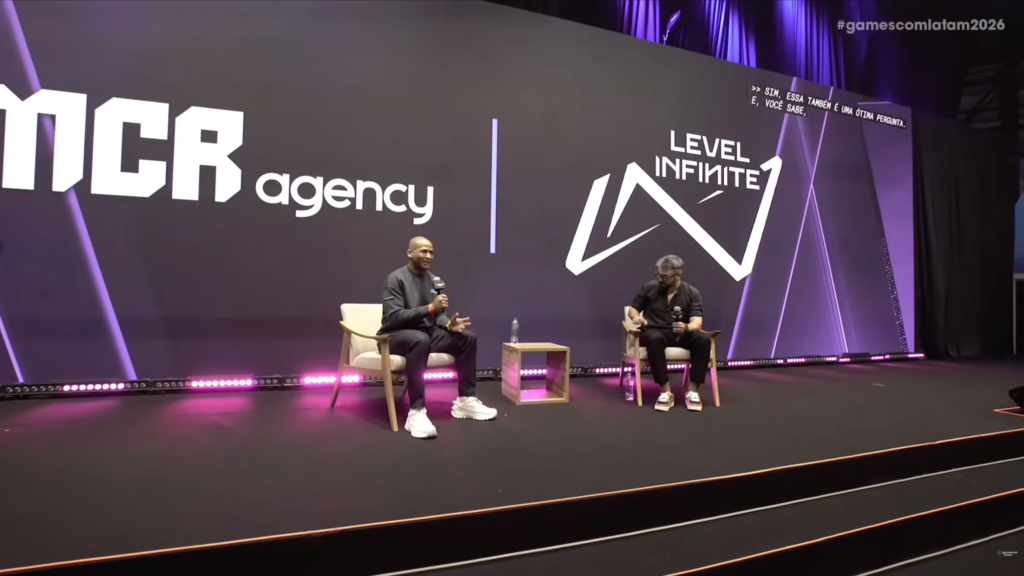
On stage at Gamescom LATAM, Anthony Crouts, Senior Director of Marketing for the Americas at Level Infinite, sat down with Sergi Cerrato Recasens, CEO of MCR, a digital marketing agency that has worked with the publisher across the LATAM region for years. The conversation landed on one idea: in Latin America, authentic creator partnerships are the emerging marketing channel, and a multi-title portfolio is what lets a publisher run it well.
What Level Infinite does in the Americas
Level Infinite is Tencent’s global games brand. Four years old, it’s built to amplify the vision of a growing roster of global studio partners and to give those studios a unified presence when they show up to players, media, and events.
“We have a lot of games under our content portfolio,” Crouts said. “What we try to do is amplify the vision of a lot of our studio partners. Give them a unifying presence so they’re not going about things on their own.”
In the Americas, that translates into a regional team built around local connections, local talent, and a line of communication that runs both ways. Insights from the ground flow back to the studios so the next round of content is shaped by what players in this part of the world actually respond to.
Creators are the new marketing channel, and authenticity is the price of entry
Crouts is point blank about where creators sit in the mix now.
“KOLs and content creators have been an important segment,” he said. “We look at it as an emerging channel. It’s a new marketing channel. When you look at your traditional marketing channels—print advertising, TV commercials, internet advertising—key opinion leaders are an important part of the mix now.”
Level Infinite’s games are built around connection between players. Creators are the people whom audiences already trust and listen to, and decide whether a game is worth trying based on what they think. Marketing’s job, as Crouts framed it, is figuring out what motivates a player to want the experience. Creators are the bridge from the game to that player.
The catch is that the channel only works if the partnership is real. Level Infinite’s rule is that the creator has to fit the game, not the other way around.
“It’s authenticity and believability,” Crouts said. “We never want to go into any of these relationships with content creators that move away from their individual brands, because they have credibility with the audiences they engage with.”
That means a lot of groundwork before a partnership is set in stone. The team digs into whether the creator’s voice, audience, and content style line up with the specific title they’d be representing. The creator has to actually play the game, enjoy it, and want to talk about it. “It’s not a fake response. It’s not a fake engagement. It’s actually an informed engagement,” Crouts said. “It’s actually an interesting engagement.”
A creator who genuinely likes a game would still drive wishlists three months after the launch window closed.
Localization is more than a language pack
A regional strategy built on creators only works if the games themselves give those creators something worth talking about locally.
“The LATAM and South America region is an important component of our overall global business,” Crouts said. “A lot of gamers are here. We want to make sure we’re engaging with them, but also tailoring the experience so they can connect with it on a personal level.”
The secret sauce is the local team. People on the ground in the region, reading what’s resonating and what’s trending, and routing that intelligence back to the partner studios so the games being built, patched, and expanded reflect what the local players actually care about.
Honor of Kings in Brazil is the working proof. Brazil was the first country outside of China to get its own Honor of Kings server. The team didn’t stop there. Local content went into the game itself, beyond a Portuguese-language pack, all shaped by what the regional team knew about the audience.
“We’ve been able to leverage that franchise, connect with the key audience here, and grow a very active and robust content community outreach as well,” Crouts said. “It’s not just a generic game that we brought to Brazil. It’s a game that we actually expanded upon and put native content into.”
For a studio partner, the payoff is a game that grows in a direction they would not have otherwise found from their home office. For a player in Brazil, it’s a title that feels made with them in mind. And for a creator in the region, it’s material they can talk about because the game speaks their cultural language.
The power of a big portfolio
Crouts was clear that the portfolio itself is the multiplier. A single title on its own has to earn every inch of attention. A title sitting under a recognized brand picks up lift from its neighbors.
“As we look at our KOL campaigns, we have a content creator talking about a specific game and they realize ‘Oh, there’s two more games under the Level Infinite umbrella. Maybe I’ll try those out as well and expose my audience and community to these other games.’ That’s the power of being under a strong brand,” said Crouts. “It’s all about the content and bringing along additional content to amplify the effect.”
Cerrato picked up on the other side of the same coin: what the portfolio does for the smaller studios inside it. He told Crouts he has watched more than one studio grow faster after joining Level Infinite than it ever did alone.
Crouts called it an amplification of the foundation. A brand reaches a user around one title, the user discovers two or three more under the same umbrella, and the creator economy around the brand starts carrying multiple titles at once. The smaller studio gets visibility, marketing muscle, and cross-audience reach it couldn’t afford to build from scratch. The creator gets a deeper library of content to talk about. The player gets introduced to a game they would never have searched for.
That is what a portfolio is actually for. It’s not a logo wall but a flywheel a single-title publisher finds hard to spin.
When the community carries the message on its own
The final idea of the conversation ties the entire model together. Reach is not the end goal. Authentic communication is.
Crouts described the moment he looks for at every launch.
“You see the engagement from the community and the audience are talking amongst themselves about something they really like, and it was a narrative that we wish to be kind of that part of the game that’s going to resonate with everyone, and you see the full loop of that happening kind of organically,” he said. “That’s when you know you have a true hit.”
This article is based on a live panel at Gamescom LATAM between Anthony Crouts, Senior Director of Marketing for the Americas at Level Infinite, and Sergi Cerrato Recasens, CEO of MCR.
Follow Level Infinite on YouTube, X, Facebook and Instagram for more stories from the teams behind your favorite games.